
Archive | Uncategorized RSS feed for this section

The More Things Change, The More They Should Change.

2 Sep

“Chris, the speed limit is 50 here.”
(I speed up from the leisurely 39 I’d been going.)

“Careful!”
(Exclaimed as she leaned away from the direction of the car approaching the stop sign on her side of the car.)

“The speed limit’s only 55 here.”
(I slow down from the 64 I’d been going.)

“What are you slowing down for?”
(As I survey a quickly-decelerating vehicle in front of us.)

“Do you know where we’re going?”
(No, but I know it bugs you!)

I’m not saying that I’m never in need of “absent-minded speed correction.” But, my extraordinarily gracious and loving wife is, shall we say, an extremely participative passenger. Deserved at times, much more often not, my vindication in this driver-passenger input melodrama is the time my mother-in-law — her mother — told her , “Gawd, Bonnie, just let the poor man drive.”

SCORE!!!

In our vehicular dynamic, it seems that whenever I drive extra cautiously, I get questioned if something is wrong. When I drive normally, I get admonished for not attending to the myriad of imminent dangers. When I am accelerating and zipping along, I am supposed to slow down; when I take it easy, I am encouraged to get a move on. From my wife’s perspective, I am either too much oriented to safety and security or too bold and reckless. I am either stomping on the gas when I shouldn’t be or riding the break unnecessarily.

It’s just like the martial arts.

What???

I practice what most would regard as a traditional martial art. By traditional, I mean that we generally have a pretty strong regard for traditions: demonstrated manners, particular protocols, certain practices, whether ceremonial actions or techniques introduced by founders or senior instructors.

More progressive practitioners of the arts would consider us to be stodgy at best. Yet, some practitioners of other traditional arts, upon observing us, might consider us to have bastardized or compromised the arts. (What? You can’t use a tea bag in the tea ceremony? Kidding. How about practicing sword cutting on pool noodles rather than bundles of straw? Not kidding.) What about allowing students to regard us too casually? (Define THAT for me.)

I find myself liking to hang onto tradition in some good measure.  I do so because I appreciate some of the best elements of what tradition offers, what it teaches, the appreciation and attentiveness it fosters. I try to find the hidden benefits of particular practices. However, I often also find myself critically reviewing what is really accomplished in maintaining certain traditions or approaches. Sometimes I wonder if I am truly more of a progressive than a traditionalist. Can I possibly be both? I even find myself thinking that change should happen simply to shake things up and move things along to the needed next places. Revolution as well as evolution.

Martial arts, particularly those coming from far-east traditions, have developed as a conglomeration of a whole bunch of things: military training and protocols, religious and philosophical perspectives and practices, cultural norms, and founder/elder/top-dog preferences and egos. It can be tough to separate the wheat from the chaff (or the meat from the hummus).

Much of martial arts and eastern philosophy draws upon metaphor or analogy that flows from nature. In nature, if something isn’t changing, it’s dying. That happens on a long-term evolutionary scale of course, but it also happens on much shorter timeframes, as in the life cycle of annual flowers. I think age 30 is about when humans supposedly begin the physical process of dying, as in breaking down rather than building up. Thirty? Sheesh. Epigenetic changes can actually happen in our own bodies, particularly due to trauma, and be passed on to our children; we’re talking DNA change in our own lifetimes!

Flowing water is fresh and powerful; stagnant water is stale and weak.

Everything is in constant change whether we know it — or admit it — or not. Nothing is the same in this very instant as it was an instant ago: no tree, no person, no frog, no stone, no building, no system, no organization. Ignore it, avoid it, or fear it, change is a given and, I think, the greater complexity of circumstances today demands that we actively pursue change in order to best adapt and stay ahead of the curve. Or the enemy.

Even in the United States military, a formal and traditional institution, change in structures and relationships has happened in order to better meet the challenges of evolving threats. Team of Teams: New Rules of Engagement for a Complex World by General Stanley McChrystal presents an engaging discussion of this dynamic.

Some of the greatest companies in the world, companies that helped change the world in big ways (can you say Eastman Kodak?) died off or diminished because they did not reinvent themselves to adapt to that very world which they helped create. I found it quite insightful to Google search for articles about companies and brands that disappeared or faltered due to a failure to adapt or innovate. Both the popular and academic literature are rife with examples and analyses.

People, leaders, fear change or don’t pursue change for a variety of reasons, some practical (such as resources), some strategic (just the wrong decision), but much more often than not change is avoided or a poor strategy is decided because of hubris. Ego, arrogance, and pride often are the reason that a particular tack is maintained. As much as some may fear losing Profit,  more often the fear that seems to drive action or inaction in many areas of life is fear of losing Position, Power or Prestige of some sort. It’s Personal. Communication and input, particularly disagreement or divergent thinking, are squelched. Role, rank and tradition are maintained but prove inadequate to meet changing circumstances. Much more often than not, institutions that best adapt and innovate to meet new demands and needs — both external and internal — involve a diversity of people in different roles and with different perspectives in sharing information and making decisions, if not even sharing authority. Yes-men need not apply.

Whether in one’s personal life or in the institution with which one is engaged or leads, perhaps we can take a lesson from my driving experience with my wife. Yes, when I find myself rather unthinkingly hitting the accelerator, perhaps I should consider my speed. Usually in my case, however, I need to pay attention and think about how I might actually stomp on that gas, to speed up, to best fit into the circumstances of what’s happening around me. And when I am unsure of where I am or where I might be going, perhaps I should actually ask for input and help.

Every good leader needs a chorus of backseat drivers and needs to be willing to actually listen and adjust accordingly.

“Chris! . . .”
Thank you, Bonnie.
What are you afraid of?

10 Aug

“I’ve always thought there was something wrong with me.”

That’s not an original line. I heard it on this insightful podcast of the Tim Ferriss Show, in an interview with Buddhist teacher Tara Brach. It was a statement uttered by a mother at the moment of her passing on.

It’s not a statement original to me, but when I heard it, I owned it. It’s a sentiment that went deep inside me. It did that because that’s how I’ve generally always felt, and still do. It’s a sentiment I carry with me and which affects a significant amount of my thoughts, words, choices, actions and reactions. In some way, I know it affects all of my relationships: those with friends, strangers, coworkers, club members, church members, children, and wife. As poignant, or disturbing, as that statement comes across, it was liberating to simply own it and admit it, so much so I that I decided I wanted to integrate it into this planned blog post.

Each of the belt colors in the ranks of Taekwondo have a meaning attributed to them. The color belt ranks largely signify growth and development according to aspects of nature. Then all of a sudden comes black belt. As I was instructed, the black belt means, “Impervious to fear and darkness.”

Impervious to fear? There are certainly lots of martial artists, black belts and otherwise, who seem motivated to act as they do because they are afraid of appearing weak, or inadequate, or incapable. There are lots of “black belts” in the business and public realms that likewise act out of those same fears, among many others.

I’m not sure about the impervious part, but I think I know a bit about the fear part.

That same Tim Ferriss podcast, at one point, explores fear a bit. Very timely. The notion of fear and it’s place in our minds, hearts, actions, choices and responses has been in my mind a lot the past months and has, coincidentally, entered into a number of discussions and been addressed in a number of readings throughout that same time. All of those varied contexts got to fear as being fundamental.

The conversation at my church men’s group meeting recently ventured to the areas of responsibility, reluctance and despair. Responsibility to be better stewards of the earth, reluctance to make life changes, and despair over uncertain futures. As I took in the discussion, I found myself noting that all of what we discussed can perhaps be summarized in one sentiment: we are afraid.

We don’t do things because we are afraid of failing. We don’t apply ourselves fully to relationships because we fear getting hurt. We work and horde and neglect because we are afraid of security in the future, or status now. Perhaps we continue to use natural resources in ways that show a fear of losing something we have, or not being able to get something we want. We do or don’t do certain things because we fear what people will think. We avoid hard decisions or resist changes because we fear the unknown consequences; how does one deal with those?

I recall one book I perused years ago — Feel the Fear and Do it Anyway — that talked about all fears boiling down to one fundamental fear: fear of not being able to handle it. If we just realized that we can ultimately handle any of the consequences of our choices and actions, we would be much more bold.

I’ve reflected on how many of our actions and motivations, particularly the less than perfect ones, can ultimately be boiled down to fear of something, and I believe this to be true. My feeling that there is something wrong with me goes, I think, to a deep sense of feeling inadequate. That sense of inadequacy is, I think, ultimately fueled by fear: fear of not being good enough, fear of not meeting others’ expectations, fear of not being regarded as capable, fear of not being able to achieve, fear of what others think of me, fear that I might somehow or sometime discover that I am simply not worth all that much.

At that men’s group meeting, I proffered that perhaps our challenge is to not act, or not avoid, out of fear, but be brave enough or, perhaps, hopeful enough, to act differently, perhaps in ways that one might call courageous. Since that discussion was originally fueled by one member’s comments about stewardship of nature, examples of courageous acts might be to make some life change regarding, say, food choices or energy use that puts one into the minority, a fearful place to be. Maybe that act might ultimately be a waste of time; maybe it will bring others to chide or ridicule us. Maybe it’s just a hard stretch for us.

I speculated to my guys at that meeting, “I wonder what life choice I can make that could be considered courageous, one choice that flies in the face of fear as the deciding factor?” I haven’t hit upon it yet. Or, maybe this post is part of it.

I think that life choices and actions that go against fear are, actually, more than courageous. I think they illustrate a view of life and the future that are based on hope, on faith and even on love. Act courageously and do the right thing, despite the fears. Act faithfully, despite the fears. Act with hope in the face of the fears. Choose to act out of love, and compassion, regardless of the fears.

Someone wise, a couple of thousand years ago, spoke to the notion of living and bearing faith, hope and love. Surely these must be remedies for our fears. Assuming so, I’ve got some attitude, heartitude, and fortitude to adjust. Living openly and courageously out of faith, hope and love. This is a life’s work. I hope I don’t run out of time.

Why did you do that? What are you afraid of?

Warning: Don’t Insert Face into Hole

26 Jul
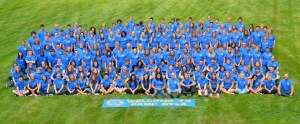
RYLA 2014-full_group

Our whole camp

Some background promotion: I recently returned from helping to run the Rotary District 5580 RYLA (Rotary Youth Leadership Award) camp. One-hundred-and-fifty incoming high school seniors and juniors were set up into 18 “families” of eight or nine youth each, along with two volunteer facilitators in each family, who all went through nearly seven days of presentations, discussion and activities geared toward helping the campers learn and live what good leadership is all about. By the time they left, these kids understood themselves and key leadership principles much better and will be able to more effectively lead, influence and serve in all aspects of their lives. Our campers leave RYLA benefitting from a process that has been refined over 24 years by some dedicated and visionary people. It’s awesome.

RYLA staff 2015 - cropped narrow

Our spectacular team!

We literally take over the University of Minnesota Crookston campus for the week, filling the dining hall, ballroom, auditorium and gymnasium. A total of 44 volunteer staff gave more than 8,000 hours across the week-plus to make the camp happen, never mind the planning and set up work during the months leading up to the camp. The quality of the young staff is amazing; they are all highly capable servant leaders in their own right. Kudos to our spectacular team!

I was having a debrief with one of the facilitators following camp and he happened to share a comment from one of his family’s youth. The comment floored me; it perfectly summarized what our camp works to achieve. His camper said (paraphrased): “I came to camp expecting you to show me the cardboard cutout of what a leader looks like; instead, you showed me ME and how to apply myself to be a more powerful leader.”

That’s IT!

We only have so much attention and energy to use in any given situation. Energy used to maintain a front, an image, to meet perceived expectations or imitate someone else, is energy and attention no longer available to actually be fully present, notice what is around us, recognize what has heart and meaning, and apply our full self to the interaction. We get told from so many avenues, across all of our years, what a leader, a boss, a teacher, a professional, a Taekwondo master, is supposed to be like; we are presented with examples of others and are lead to believe that if we just imitate them we will be powerful or influential.

Think Star Trek: if power is diverted to the shields (image, front, role) then there is not enough power to propel the ship or to use the weapons (personality, strengths, gifts, tools). If we are using energy to stretch and contort ourselves to fit into the frame of the cardboard cutout, then we have less (or little, or no) energy left to effectively apply ourselves as leaders in our position.

We experience innumerable bosses, managers, teachers, CEO’s and others who expend a lot of energy to act in ways that keep to some role or image, but who actually have much reduced positive influence as leaders because what they are attempting to do is simply not them; they are just trying to insert their face in the hole in the cardboard cutout. At best, it’s misunderstanding and misdirection. At worst, it’s ego and fear driving behavior, often to the point of neglecting or damaging others to protect one’s ego and preserve a particular image.

Bruce Lee cutout crop reduced

There was only one Bruce Lee. Life-size cutout available on Amazon.

I’ve seen martial arts instructors and masters who act the way they imagine the ideal instructor or master to be, or as they have been modeled or told to be. In those instances, if a student is lucky, they are simply subjected to a cardboard caricature; if they are not lucky, they end up influenced by, or suffering under, an egoistic ass, or a bully. I’ve struggled to find my right place as an instructor and master and, to the degree I’ve done poorly, the results are less than satisfactory, to say the least.

I recall my son’s comment to me as I approached my first master’s test, he being in his later teens at the time, with a dozen years of martial arts exposure under his belt: “Maybe you can be the nice master.”  It’s not about nice or not nice, per se, but I knew what he meant and he, the perceptive and impressionable youth, definitely knew what he meant. My son knew me to be a certain kind of man and personality, with particular gifts, and he didn’t want me to play any other kind of role or to attempt to morph into another type of personality. He desired me to be an excellent leader, authentically applying who I was and what I brought to the opportunity. He knew that’s where my real presence and power would come from. It’s what he and others knew, loved and respected in me.

Wonder Woman reduced

Ladies are susceptible, too.

Whether we are uniquely created and gifted by God, or are the one random, particular variation of the infinite possibilities of the cosmos and our environment, I believe the best of who we are and what we have to offer comes as us, from us, not from external slogans, predefined roles, popular or hackneyed images, or the latest bestseller by a multimillionaire CEO. We must recognize, claim and live our preferences and values. Realizing and living this is not easy; it requires deep honesty, vulnerability, trust, courage. At the end of the day – or the end of a life – what lies there within is, after all, still the truth, whether shared, used, hidden, wasted or otherwise. It’s all we really have and, I believe, is the best we have to give.

I’ll simply close with the opening lines of  Now I Become Myself by May Sarton:

Now I become myself. It’s taken
Time, many years and places;
I have been dissolved and shaken,
Worn other people’s faces. . .

Four or Five Pairs of Pants

11 May

The other evening I got a text from one my two female instructors who were covering classes in my absence as I attended a Rotary appreciation dinner. The report came in: “Class went well.” Those short words referenced the kids class, and meant more than their brevity portrayed.

You see, two weeks ago, those same two ladies covered classes for me and things did not go as well. The class was much larger, the mix of kids was a challenge, and there apparently must have been a full moon; the energy was high and the manners were low. I had to have a talk with the kids and they had to write apology notes. They made it hard for my ladies!

Taekwondo has official tenets. They are: Courtesy, Integrity, Self Control, Perseverance, and Indomitable Spirit. Courtesy is first, and for good reason: Continue reading

Being More (Para) Sympathetic. Or not.

4 Apr

Fight or flight. It’s completely natural. It explains a lot of how we act and interact. A whole bunch of professional trainer types have been talking and writing about it the past decade or so to explain human behavior and, of course, point out how they have the special insights and approach to help you act in ways that manage or overcome this innate tendency. Personally, I think they just want to appear smarter than they really are, because they get to use cool expressions like sympathetic nervous system and adrenal medulla.

So, there’s Norepinephrine (hey, at least I actually started college as a biology major) and then there’s Matt.

Matt is a teenaged Taekwondo student whom both I like and yet want to punch in the head and throw out of classes. Which of those sentiments I feel more depends on the exact second, and it may change second to second. Apparently, Matt wants to get tossed out of classes so, even after enrolling, and two years of practice, and choosing to display good ability and attitude at surprising times, he generally dogs it, really badly. REALLY badly. Embarrassingly badly, for both him and us.

Of course, I imagine thousands of people looking in on class on their TVs via hidden cameras, like a reality television show, thinking, “How can they let him get away with that?” There are, after all, those hidden cameras that allow strangers to watch our lives all the time, because it seems still too often I must resist the temptation to adjust my actions so as to avoid their disapproval, monitoring my life according to the criteria, “What will people think?” But I continually get better at not doing that. Another topic, another time. Back to Matt and us.

Matt’s parents tell me that he would prefer to sit home and play video games. But, he stays enrolled, gets dropped at our door, and goes through the motions (BARELY) of Taekwondo. His parents really want him to be kept in and keep sending him. Why doesn’t he get to decide? Well, his decision would be to do nothing except sit at home and play video games. (Nothing wrong with that on some levels, but again, another topic for another day.) I supposed he COULD somehow quit, but he hasn’t yet. I think he’s trying to push us to make the decision. There are other matters of concern, too, of which I won’t go into detail, but which are motivating factors for wanting to have things work out for him.

I’ve kept Matt in because I’m not sure what to do with him, how to best handle him, with the belief that it can be good for him. He still keeps coming, after all. I don’t want to throw him away until we’ve tried and know we can’t succeed, at whatever we’re supposed to succeed at. I don’t like to fail on a student, particularly a youth. (Fail with other people? Well, maybe sometimes I can live with it; it depends on the person.)

Being nice and encouraging? It works for a few minutes. (Yay! Motivation! Response!) Barking at him or punishing him? Same. The constant nice and encouraging bit doesn’t work for long, so I debate trying a constant bark and punish approach, like a psycho drill sergeant. Crazy tough love and all that.

In Man’s Search for Meaning, Viktor Frankl discusses how different prisoners would behave in the midst of the horrible conditions and treatment in the Nazi concentration camps. Frankl points out that in humans, between a stimulus and a response – between the external stimulus and, perhaps, our innate fight or flight or freeze reaction – there is choice. Choice is what moves us to better places than a pure fight or flight reaction or, perhaps, only seeing, and responding as, black or white.

All of this – Matt’s parents enrolling him and wanting to keep him in, his behavior, how we work with him or whether I choose to invite him out – involves choice. Psycho drill sergeant might work, for a while at least, because Matt might react, experience a bit of flight or flight or fright. Or, it might not work. And then what? Ultimately, if we take it too far, he WILL choose to leave, one way or the other. We’re assuming for now that’s not the best option.

Somehow, he might choose to stay, and live up to the potential we’ve seen.

Fight or flight, black or white. Do class the right way or get tossed out!

Between black and white, we know there are, at least, fifty shades of gray. Maybe one of those shades is the right color choice. Maybe not. But an all black and white house would be ugly. A black and white relationship is, minimally, boring. God created much more than that; have you stopped and looked at the roses recently? Even black and white TVs — like the ones all of those judgmental people are watching us on all of the time – are actually mostly images of gray.

Color is a whole lot better than black and white, even if Matt might not enjoy a different color belt for a while.

For the time being, I choose not to give up on Matt. I choose not to let his action (or lack thereof – ugh.) lead to a typical reaction. Maybe I have to actually tell him that: “Matt, you and I both know you’re jerking us around and hoping you don’t have to be here. But you started this because you wanted to, for some reason. And you’ve got great potential I see. I’m not going to give up on you.” Maybe that’s what he needs to hear. And just maybe (and surely waaaaay too slowly) – Matt will choose differently. Because I chose differently than black or white.

A cascade of better choices, rather than just a cascade of sympathetic nervous system hormones and reactions. All because someone chose to respond to a stimulus differently than normal, than expected. Haven’t you heard it, or said it, often: “I had no choice.” Not true. Not at all.

Bringing Up the Rear

29 Mar

I messed up at promotion testing we conducted this past Tuesday. There I had in front of me kids, ready, nervous, and excited to try for their next belt. Five year olds through eleven years olds. (The teens and adults came later.) They were to perform a pattern/form. They were to perform some self-defense techniques and kicking combinations. They were to demonstrate an appropriate amount of attention, manners, and self-control. Perhaps know some terminology. And, they must complete a board break, or several breaks, depending on rank.

Where I messed up was actually a few hours prior to testing. I went to my board supply and realized that I had essentially run out of decent kid boards, boards that were of a nature or size that a child can break with a variety of kicks, if properly done. What I had remaining were lots of adult boards, boards that took an adult amount of power to break. Oops. “Well,” I thought, “I guess we’ll just figure it out.” I made up my mind that no youth was going to not complete their test that night, at least due to a board break. I would be sure to help them as much as they needed to succeed. And they did.

The best boards went to the lowest rank and youngest kids. Most had to be allowed to use a very basic kick, done more powerfully, to get the job done. And they did. There were extra chances, extra drama, and some extra coaching, but I wasn’t going to hold them back for my mistake. Rather, I helped them step it up to get the job done.

The greatest challenge came with the last two kids who tested, two boys, each ten years old, going for their Purple Trim rank, the first rank with extra techniques, more advanced techniques, and several board breaks. Up to that point it had been tough to coach kids through their single board break. These guys would face several. Here we go!

There was doubt, frustration, fear and tears. There were moments when I am sure they thought I was asking them to do something impossible. I told them I’d given them a big challenge and I would help them succeed, but they had to do it. I told them that this promotion would not so much test their technique as much as their heart, their perseverance, their indomitable spirit. We had to observe, support, help, change, and rearrange. We helped. They stuck with it and did it.

In the days since that test, I’ve thought about supporting and coaching the students to success. I’ve thought about what I wrote earlier in the first paragraph: I would be sure to help them as much as they needed to succeed. That’s what a leader does.

I am the leader of those students. I also have a team of black belts and assistants. They lead them, too. I have colleagues in Rotary whom I lead as a club president and a district chairperson. I have leadership teams in BNI chapters I work with. I have a business partner outside of Taekwondo. I have friends. I have a wife.

Once I got done patting myself on that back for a job well done at testing, I asked myself in what ways I give – or fail to give – that kind of support in other leadership and collegial contexts. Do I pay attention to what someone is doing, to how they are doing, to how they are struggling and to what they need to get the job done? How often do I ignore and neglect what my people need? How often don’t I observe, ask, or communicate? How often do I forget to assure that I’ll provide needed support, and then follow through on that assurance by making sure they have what they need to succeed?

I said earlier that I messed up at testing. Actually, I think I’ve messed up this past year. It’s been a tough past year, and I’m not sure I’ve made the grade as a leader, or even as a friend or colleague for that matter. There’s been a lot more “me” than “them.”

Yes, it’s nice to be master instructor, it’s nice to be president, it’s nice to be chairperson. It’s nice to be honored, to have position, recognition and responsibility. But that by itself won’t help my people get the job done well. Nor will purely telling and directing. I can’t just put things on autopilot, simply start the ball rolling and wait for results. I can’t assume everything is alright unless someone says otherwise. To ensure that all my colleagues, my teammates, my crew can succeed at what they are doing, I must be sure to be present, to be aware, to communicate, to ask, to support, to reassure, and then I must support and serve. Let’s say it again: support and serve.

Imagine seeing leadership (or teamwork, or spouse-work, or friendship) as single-minded support and service. Imagine that.

Sit. Fetch. Roll over. Speak.

2 Mar

I recently met with a young entrepreneur whom I’ll call Blair. Blair is an intriguing young woman and a go-getter; she started a service business while in college, built it upon good values and service, and ran it with a drive to make it successful.

When we first met several years ago, I decided to use Blair’s service for my own Taekwondo school. The service wasn’t anything I couldn’t do myself, but it would enhance my business a bit and ensure it got done regularly.

Because of her ambition to apply her business skills in bigger ways, Blair stepped aside into bigger ventures. I don’t recall if our contract was fulfilled or if there was a blip in that. I do recall being a bit confused and frustrated at the time and wondering about Blair’s overall maturity and reliability, with some residual, lasting impression.

Blair’s request to meet with me was so she could apologize for any confusion and frustration, to say that she was sorry for letting me down and – surprisingly — Continue reading

The Voice. (Not a tribute to Adam Levine or Blake Shelton)

5 Jan

I lost my voice just recently, teaching classes. Not a complete loss; I’d lost the usual projection and boom. I was more raspy and soft, and words were catching in my throat, voice cracking.

I’d started classes just fine but by half-way through the first youth class, a bright-eyed 10 year old girl declared, “Master Chris, you’re losing your voice!” Of course, that opened the floodgates and it quickly became an obvious focus. “Why did you lose your voice?” a six year old asked. “Yeah, why?” inquired another. “Master Chris lost his voice!” “Do you need help finding it?”

The explanation I offered was that it was because I had to yell at them too much, that they were too loud and didn’t pay attention. All true, but they knew I was teasing-admonishing. Continue reading